Telegram Orchestration Agent with Modular Tool Delegation
Telegram-based AI agent that acts as a central orchestration layer, interpreting user messages and delegating tasks to specialized sub-agents and tools.
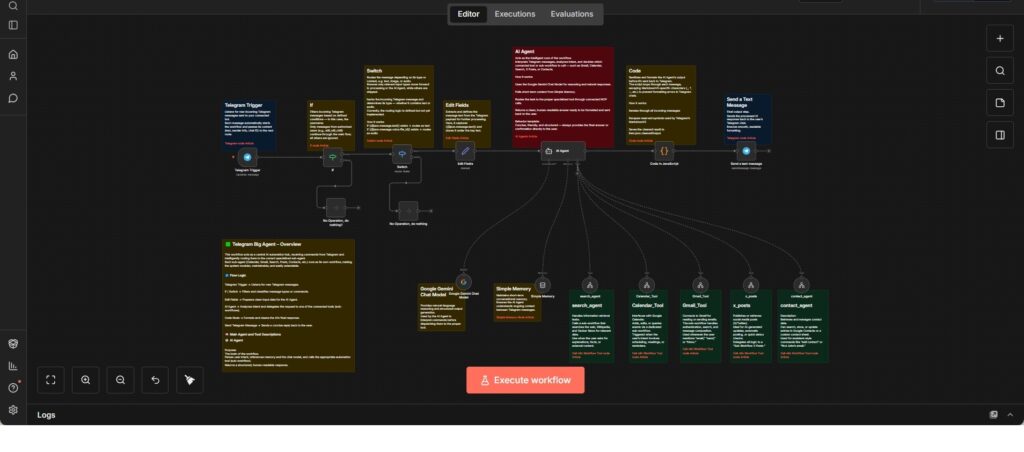
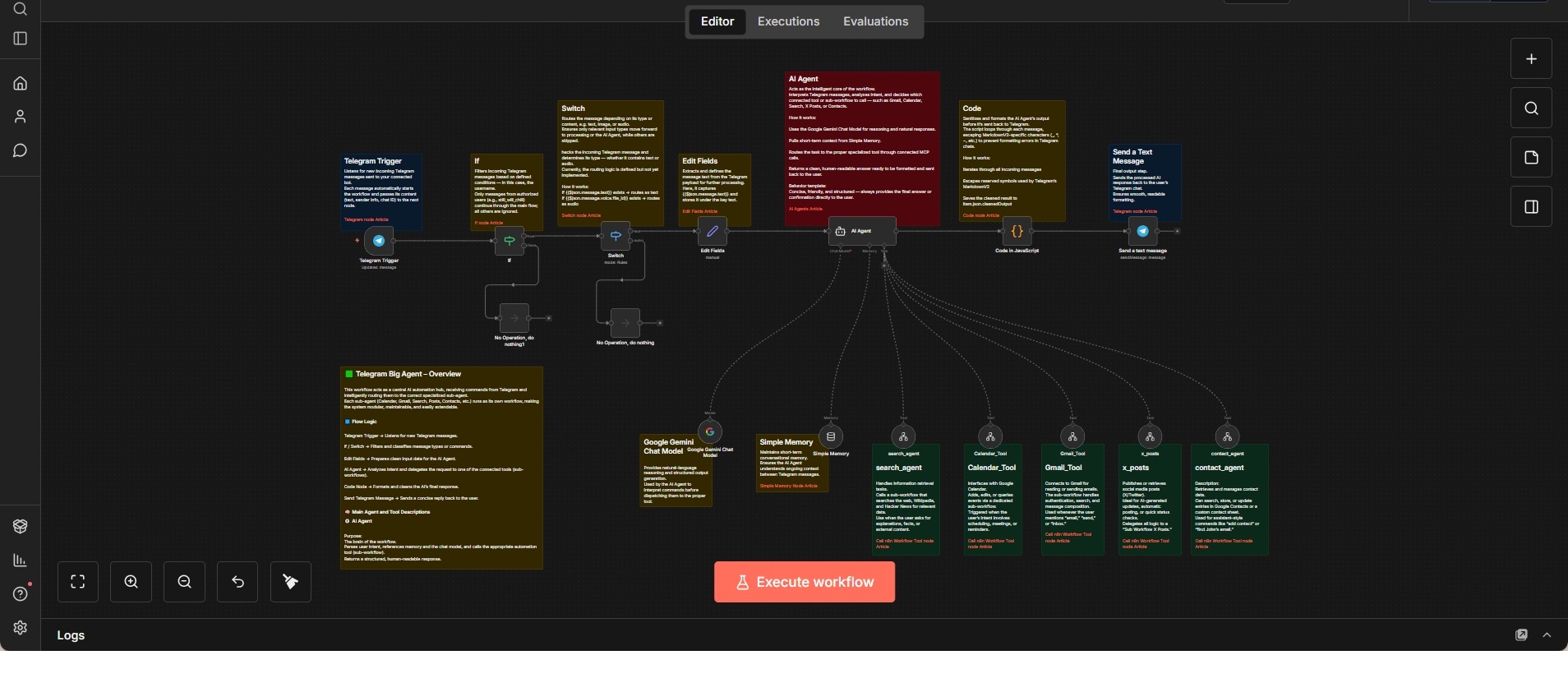
This workflow implements a comprehensive Telegram-based orchestration agent that serves as the primary entry point for user interaction. Incoming Telegram messages trigger the workflow and are processed through a structured preprocessing layer before being passed to the core agent.
Early steps in the workflow handle message validation, filtering, and normalization. Basic routing logic ensures that only supported message types are forwarded, while unsupported or empty inputs are safely ignored. Relevant fields are extracted and prepared to provide the agent with a clean and predictable input structure.
At the core of the workflow, an AI agent uses a chat model for intent interpretation and decision-making, supported by a simple memory component to retain short-term conversational context. Based on the resolved intent, the agent determines whether to respond directly or delegate execution to one of several connected sub-agents or tools.
Available integrations include external search, calendar operations, email handling, contact management, content posting, and other utility functions. Each capability is encapsulated behind a dedicated sub-agent or tool, keeping execution logic separate from reasoning and orchestration.
Before responding to the user, the agent output is formatted and normalized through a dedicated processing step to ensure consistent Telegram-compatible responses. The final message is then sent back through the Telegram API.
The workflow is designed as a modular control layer that centralizes decision-making while delegating execution, making it easier to extend the system with additional tools, sub-agents, or validation steps without increasing overall complexity.