Multi-Agent Software Development Workflow with Supervisor, Reviewer, and Documentation Roles
Role-based multi-agent workflow that simulates a complete software development process, from implementation to review and documentation.
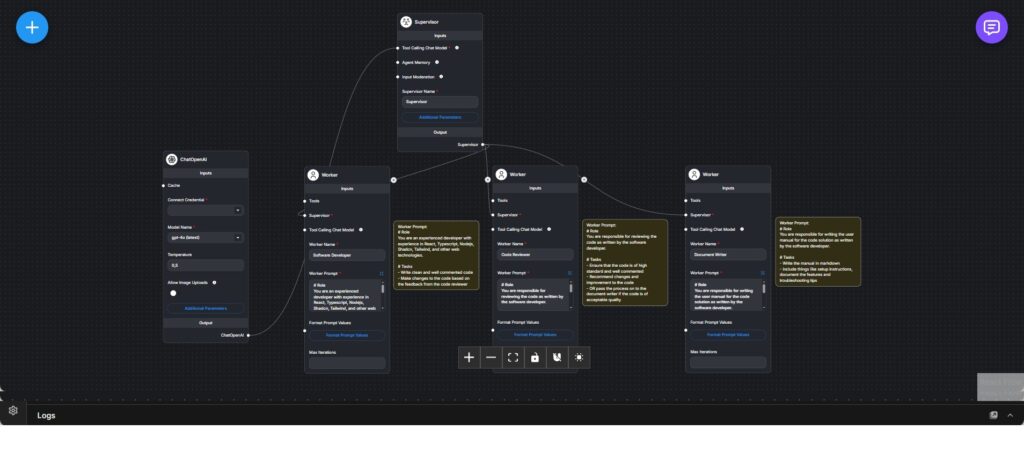
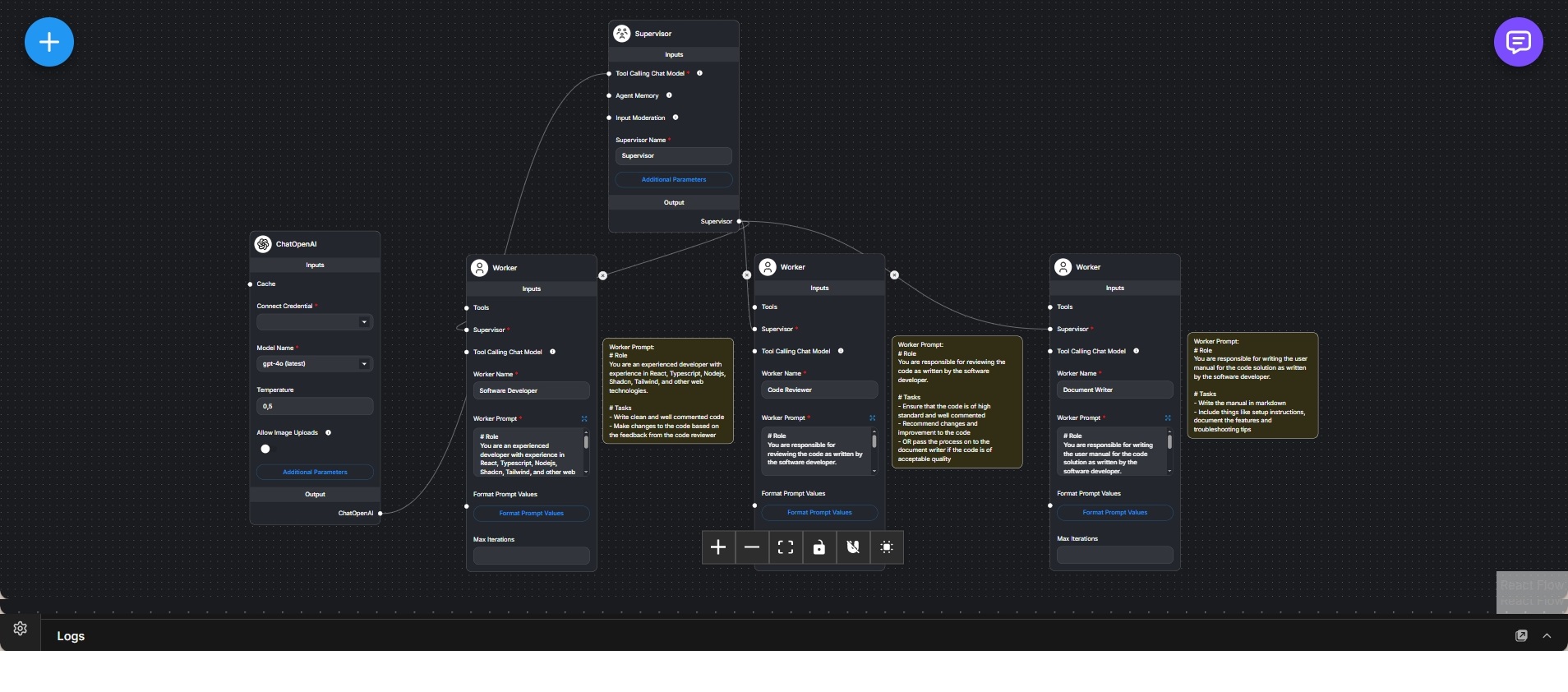
This workflow implements a structured, role-driven software development pipeline using a supervising agent and multiple specialized worker agents. It is designed to mirror real-world engineering team dynamics rather than treating code generation as a single-step task.
A cloud-based OpenAI chat model provides the reasoning backbone for all agents, ensuring strong code understanding, review quality, and natural language documentation. The supervisor agent acts as the central coordinator, controlling task assignment, sequencing, and iteration across workers.
Three worker agents are defined, each with a clearly scoped responsibility. The software developer agent is responsible for implementing or modifying code based on requirements and feedback. The code reviewer agent evaluates the developer’s output, checking for correctness, readability, and adherence to best practices, and provides structured feedback. The document writer agent produces user-facing documentation once the code reaches an acceptable quality threshold.
Each worker operates under a dedicated role prompt that defines expectations, constraints, and output format. The supervisor routes tasks between workers, enabling iterative improvement cycles where code can be refined based on review feedback before documentation is finalized.
This workflow demonstrates how agent systems can model collaborative engineering processes, separating concerns between implementation, quality assurance, and communication. It emphasizes review loops, accountability, and staged delivery rather than one-shot code generation.
The design is well suited for complex software tasks, internal tooling, technical documentation generation, and experiments in AI-assisted development workflows that aim to reflect professional engineering standards.