Invoice Analysis Workflow with Structured Output Parsing
Document analysis workflow that extracts structured invoice data using a language model and a schema-driven output parser.
This workflow implements a document analysis pipeline designed to extract structured information from invoice documents. It focuses on deterministic output rather than conversational responses, making it suitable for downstream automation and data processing.
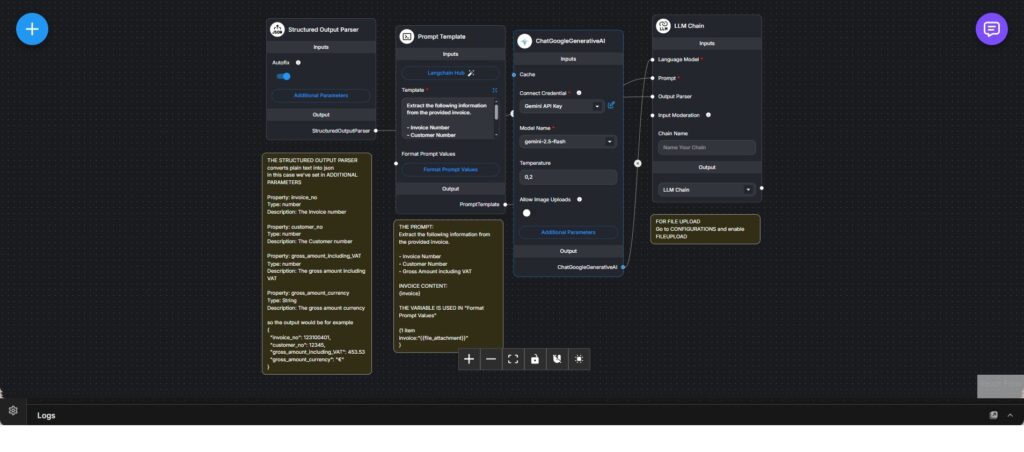
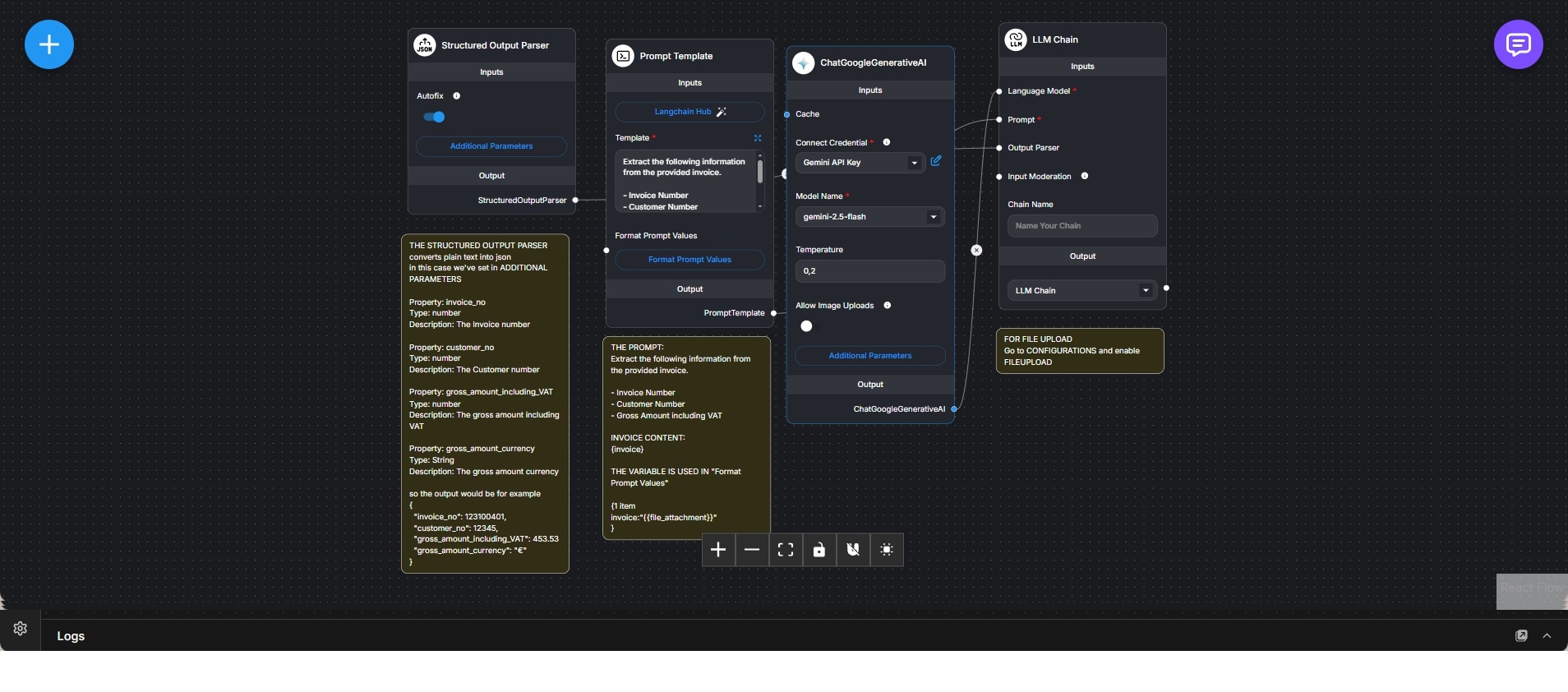
An uploaded invoice file is passed into a prompt template that explicitly instructs the language model to extract predefined fields such as invoice number, customer number, gross amount including VAT, and currency. The prompt is tightly scoped to ensure the model produces only the required information.
A structured output parser defines a strict schema for the expected result. Each field is typed and described in advance, allowing the model’s free-text output to be converted into a predictable JSON structure. Automatic fixing is enabled to increase robustness when the model output deviates slightly from the expected format.
The language model is invoked through an LLM chain, which combines the prompt template, model configuration, and output parser into a single execution step. Model parameters are tuned for low creativity to prioritize accuracy and consistency over generative variation.
The result is a clean, machine-readable object that can be consumed by accounting systems, validation logic, or further automation steps. The workflow cleanly separates document input, extraction logic, model execution, and output normalization.
This setup is well suited for invoice processing, document digitization, and business workflows where structured data extraction from unstructured documents is required.